In photography, some locations are so visually potent they become rites of passage. In Vietnam, these “Big Four” spots aren’t just pretty backgrounds—they are complex environments where you can master specific technical and artistic challenges.
Whether you are chasing the high-speed motion of Hanoi or the abstract symmetry of the coast, a private Vietnam photo workshop ensures you return home with gallery-quality files rather than just “tourist snaps.”
1. Long Bien Bridge: A Study in Leading Lines and Grit
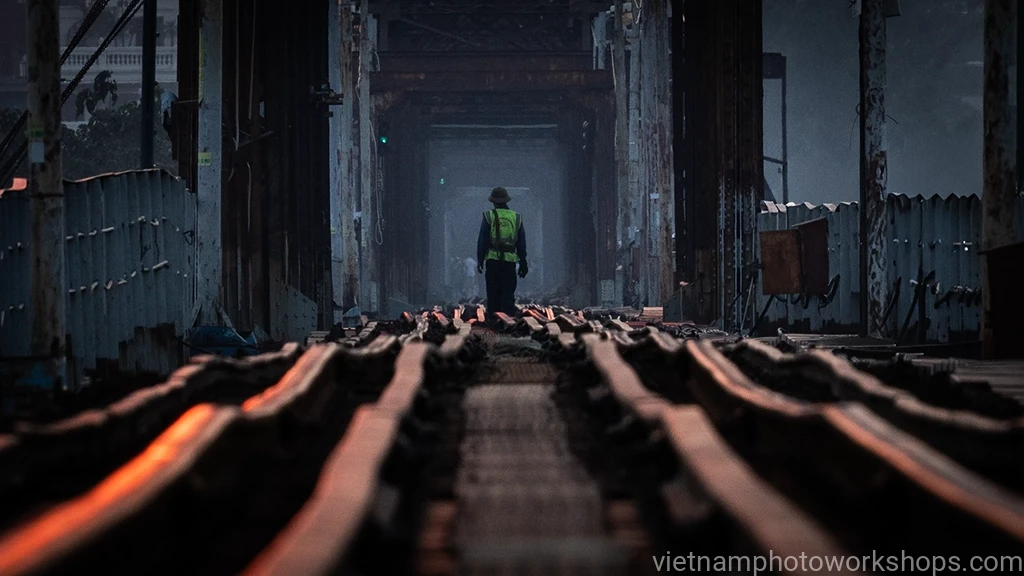
Built by the French and standing as a symbol of Hanoian resilience, the Long Bien Bridge is a masterclass in industrial geometry. The rusted steel girders and narrow lanes provide the perfect playground for practicing linear perspective.
Workshop Technical Focus:
- Vanishing Points: We use the bridge’s iron skeleton to create “leading lines” that pull the viewer’s eye deep into the frame.
- The “Panning” Technique: As motorbikes stream past, we practice slow-shutter panning (try 1/15s to 1/30s) to blur the background while keeping the subject sharp, symbolizing Hanoi’s relentless pulse.
- Timing: We arrive at 5:00 AM. Why? Because the low-angle “Golden Hour” light creates high-contrast shadows within the steel frame that you simply can’t get at midday.
2. Quang Phu Cau Village: Color Theory & The “Nat Geo” Shot
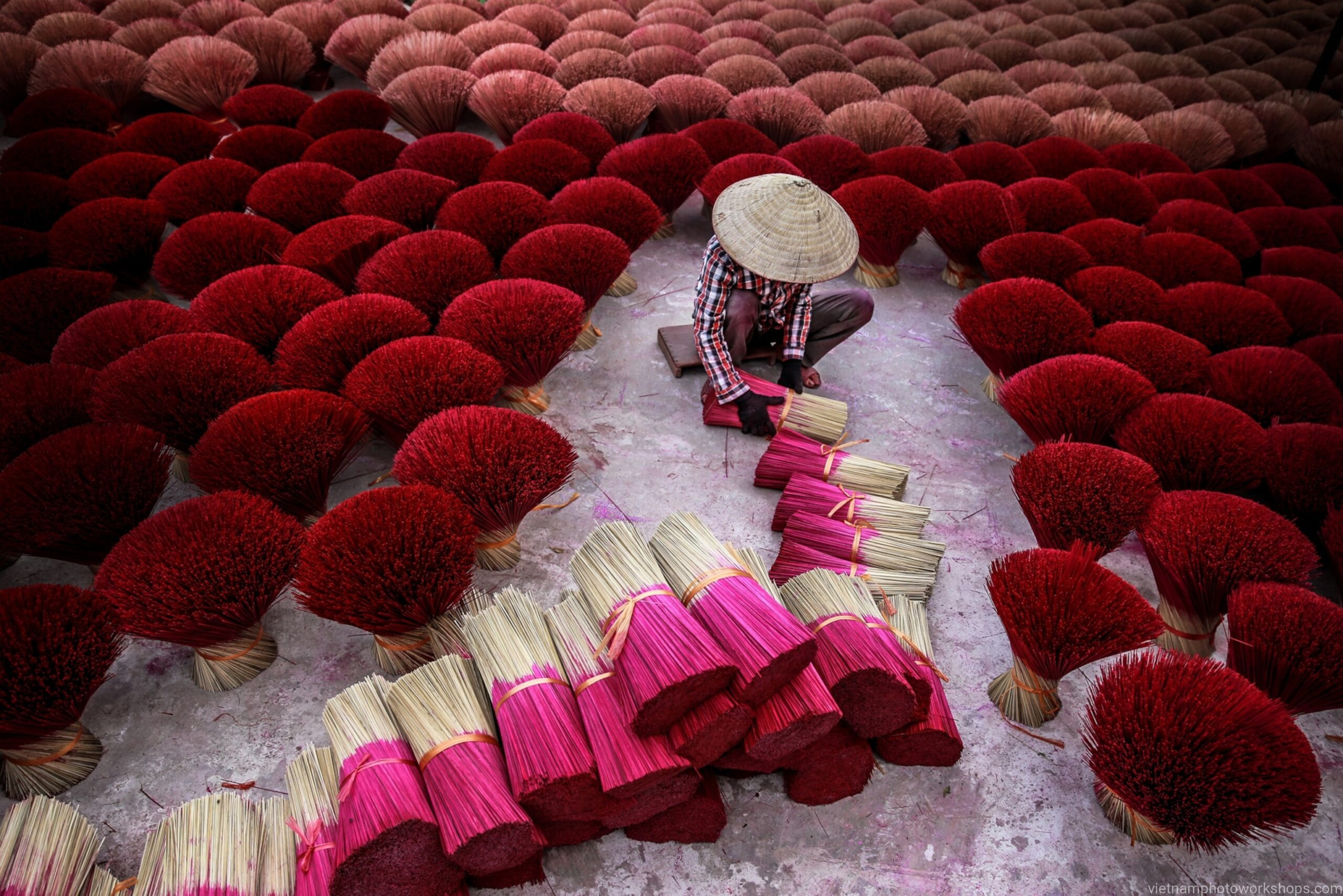
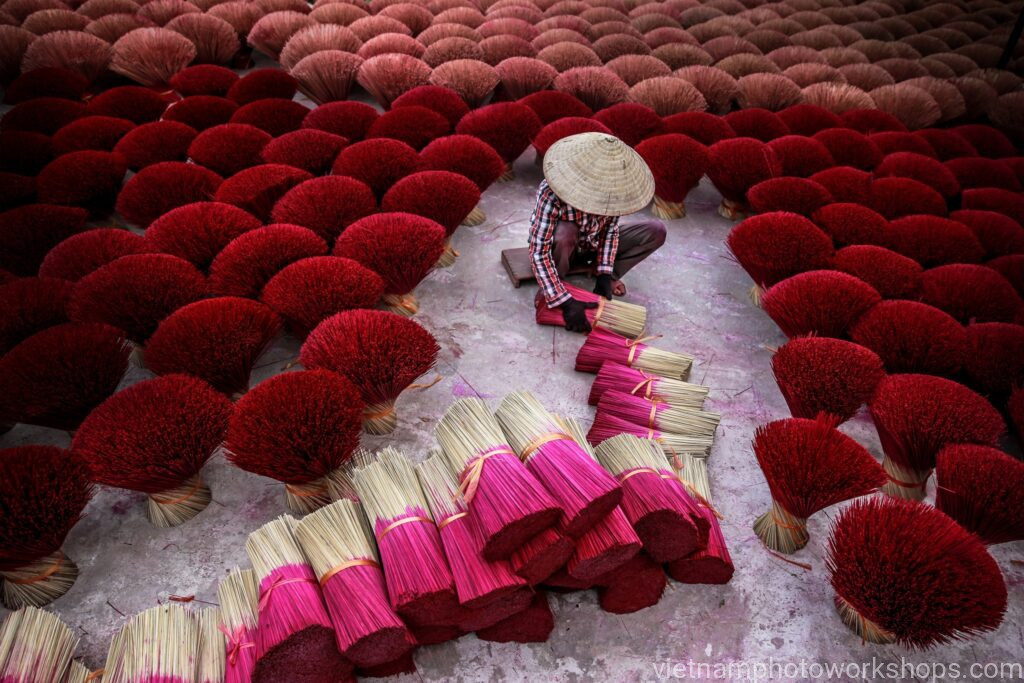
If you’ve seen the world-famous image of crimson incense bundles in National Geographic, you’ve seen the work of Tran Tuan Viet. This village is where that iconic shot was born, and it’s the ultimate location to study Color Theory.
Workshop Technical Focus:
- Symmetry and Patterns: Inspired by Viet’s portfolio, we look for “Repetition” and “Rhythm.” We’ll practice shooting from high vantage points to turn the courtyard into a 2D abstract painting.
- White Balance Mastery: The intense red of the incense can often “trick” a camera’s sensor. We’ll teach you how to manually adjust your K (Kelvin) settings to ensure the reds remain vibrant without losing detail.
- The Human Connection: We don’t just shoot the sticks; we document the artisans. This is the place to practice environmental portraiture, showing the relationship between the maker and the craft.
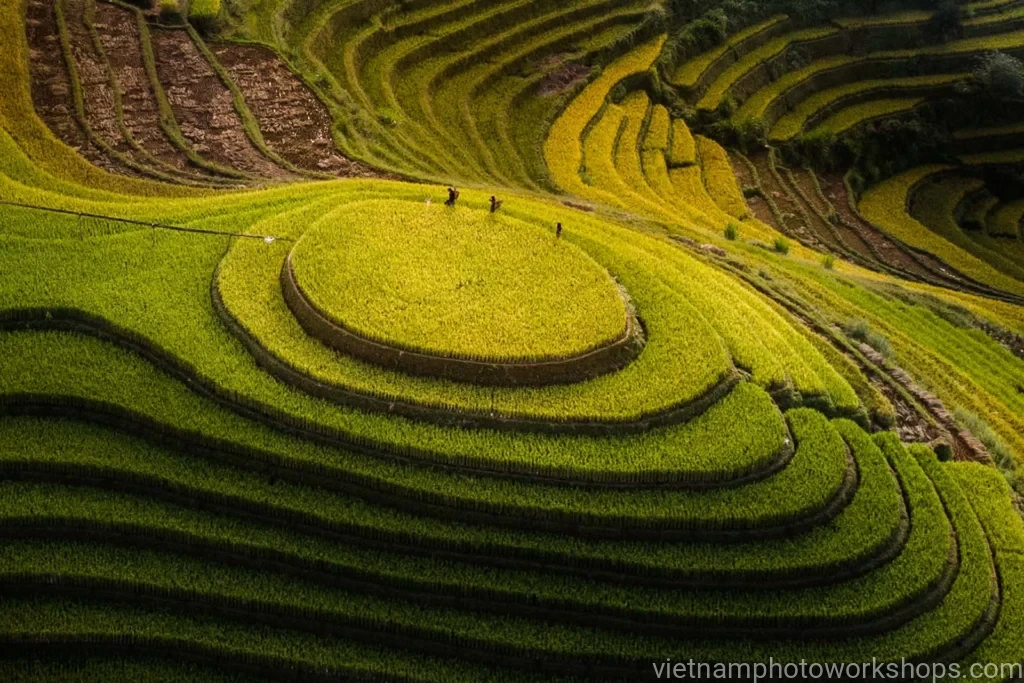
3. Northern Rice Terraces: Managing Scale and Depth
Whether in Mu Cang Chai or Sapa, the rice terraces are arguably the most impressive hand-carved landscapes on Earth.
Workshop Technical Focus:
- Focal Compression: We’ll move away from the wide-angle lens and reach for the 70-200mm telephoto. By “compressing” the distance, we make the layers of the terraces appear to stack on top of one another, creating a more dramatic, painterly effect.
- Dynamic Range (HDR): Mountain weather is tricky. We’ll master Exposure Bracketing—taking multiple shots to capture the detail in both the bright sky and the deep, shadowed valleys.
- Human Scale: A terrace is just a hill until you put a person on it. We look for the “lonely farmer” to provide a sense of scale and a narrative hook.
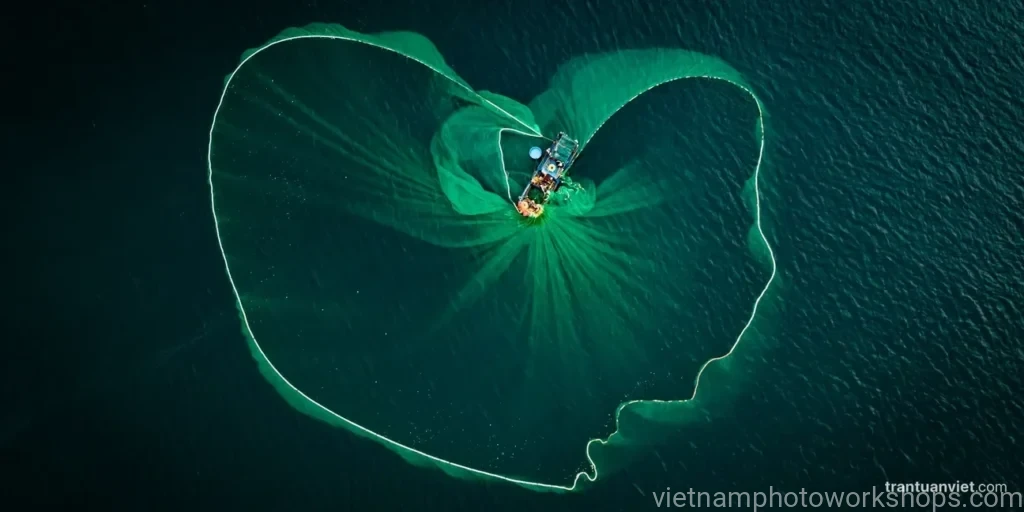
4. Coastal Fishing Nets: Abstract Art from the Air
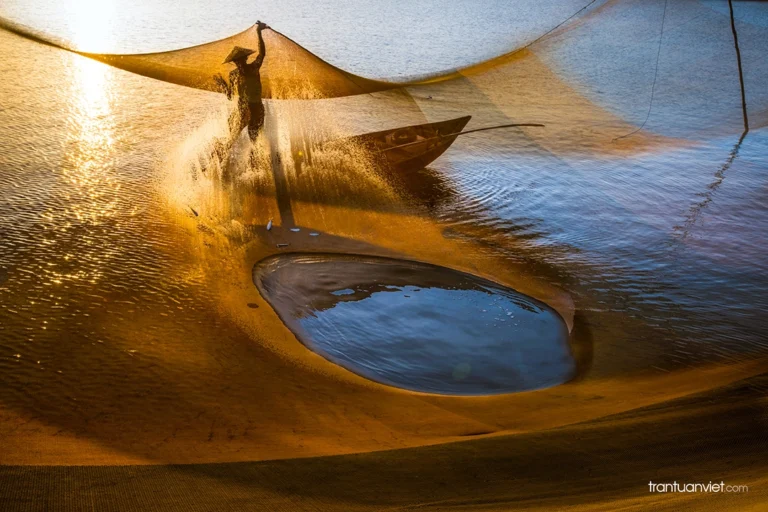
Along the central coast, the “giant lift nets” look like golden spiderwebs floating on an emerald sea. This is a favorite for those interested in Aerial Photography and Abstract Composition.
Workshop Technical Focus:
- Aerial Perspective: For those with drones, we focus on the 90∘ “top-down” shot. We look for the “flower-like” shapes the nets create when they are hauled from the water.
- Color Contrast: We study the interaction between the complementary colors of the orange/yellow nets and the teal/blue water.
- The Decisive Moment: Timing the “cast”—the split second the net hits the water—requires a fast shutter speed (at least 1/1000s) and an understanding of the fishermen’s synchronized movements.
Why the “Local Eye” Matters
You can find these spots on a map, but you can’t “find” the light or the story without experience. A local Vietnam photography guide knows which village has the best incense drying today, which terrace is currently “golden,” and where the fishermen are most active.
Masterclass Tip: Don’t just follow the crowd. During our workshops, we look for the “hidden angle”—the shot that hasn’t been posted a thousand times on social media.
Elevate Your Portfolio
Every one of these locations tells a story of tradition, labor, and beauty. On a private Hanoi photography tour or a multi-day workshop, you’ll learn the technical precision required to do these stories justice.