Every autumn, the northern highlands of Vietnam undergo a biological transformation that is a dream for color theorists. As the chlorophyll in the rice plants breaks down, the landscape shifts from a lush green (approx. 520–550 nm) to a radiant gold (570–590 nm).
For a participant in a Vietnam photo workshop, this “Golden Season” is more than a scenic view; it is a complex study in light, geometry, and atmospheric perspective.
Prime Geographies for the Golden Harvest
Mu Cang Chai: The Geometry of the “Raspberry Hill”
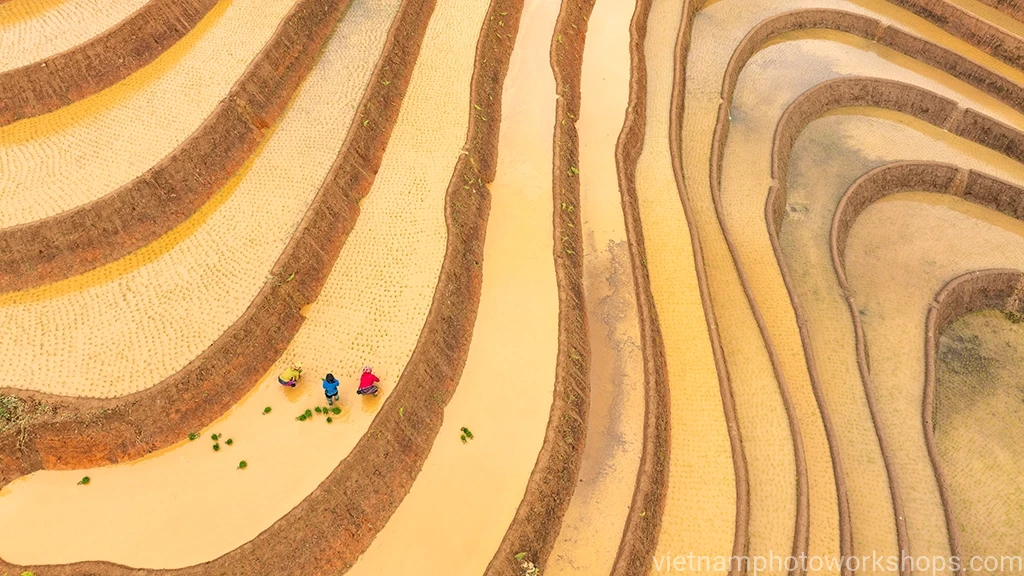
Mu Cang Chai is home to the most iconic “Mam Xoi” (Raspberry) terraces. These are masterclasses in radial symmetry.
- The Workshop Goal: We focus on the “top-down” perspective and the use of leading lines that spiral toward the center.
- Key Spots: La Pan Tan and Che Cu Nha offer the steepest gradients, perfect for studying how light grazes a surface to reveal texture.
Sapa & Y Ty: Atmospheric Perspective and Mist
If Mu Cang Chai is about geometry, Sapa and Y Ty are about atmosphere. The higher altitude means more frequent “sea of clouds” phenomena.
- The Workshop Goal: Mastering depth of field in low-visibility conditions. We use the mountain ridges as silhouetted layers to create a sense of infinite distance.
Hoang Su Phi: The Dramatic Shadow Play
The terraces here are carved into steeper slopes, creating high-contrast environments.
- The Workshop Goal: Managing Dynamic Range. You will learn to expose for the highlights on the golden stalks while retaining detail in the deep, shadowed valleys.
The Technical Toolkit: From Optics to Aerials
1. Mastering Lens Compression
While wide-angle lenses (16–35 mm) are great for the “big picture,” the secret to professional terrace photography is the telephoto lens (70–200 mm or even 400 mm).
- The Technique: By zooming in from a distance, you “compress” the layers of the terraces. This makes the vertical stack of the fields look tighter and more dramatic, turning a landscape into an abstract pattern of color and line.
2. Managing the “Golden Hour” Light
The “Golden Season” is best shot at the “Golden Hour.” However, the high contrast between the bright sky and the dark mountain shadows can exceed your sensor’s dynamic range.
- The Fix: We teach the use of Graduated Neutral Density (GND) filters or Auto Exposure Bracketing (AEB). By taking 3 to 5 frames at different exposure levels, you can blend them later to ensure the sun isn’t “blown out” and the shadows aren’t “crushed.”
3. The Aerial Perspective (The “Viet” Style)
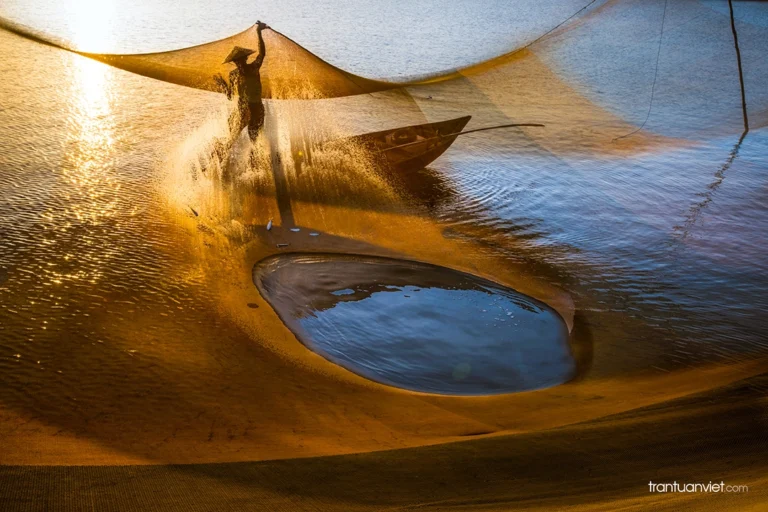
Inspired by masters like Tran Tuan Viet, we utilize drones to find the “Hidden Geometry.”
- The Skill: Learn to fly at a “top-down” 90∘ angle to turn the harvest into a 2D canvas of patterns. Note: We always adhere to local flight regulations and respect the privacy of the harvesters.
Advanced Composition: The Human Element
A landscape without a subject lacks a “soul.” During our workshops, we focus on the Human Scale.
- The Golden Ratio: Placing a farmer in a conical hat at the intersection of the “Rule of Thirds” or along the “Phi Grid” (approx. 1.618) provides an immediate focal point.
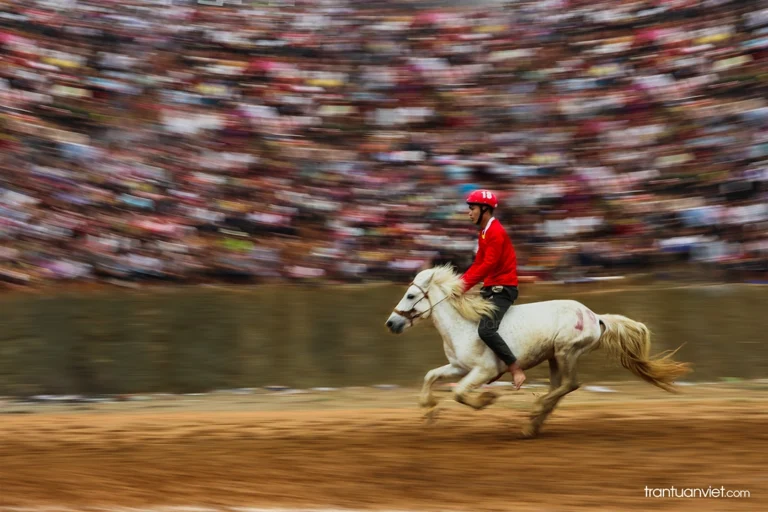
- Motion Blur: We experiment with slower shutter speeds (approx. 1/15s to 1/30s) while tracking a harvester. This blurs the motion of the rice being threshed while keeping the person relatively sharp, adding a sense of labor and energy to the frame.
Seasonal Timing: Tracking the “Golden Wave”
The harvest doesn’t happen all at once. It flows like a wave based on altitude and temperature:
- Late August – Early Sept: Sapa and Y Ty (Higher altitudes turn gold first).
- Mid-Sept: Tu Le and lower Mu Cang Chai valleys.
- Late Sept – Early Oct: The peak of Mu Cang Chai and Hoang Su Phi.
Pro Workshop Tip: Weather in the mountains is unpredictable. We teach you how to use “Bad Weather”(fog, rain, and moody clouds) to your advantage. A misty morning often yields more “fine art” results than a standard sunny day.
Photography Ethics: Respecting the Livelihood
These terraces are not just a “backdrop”; they are a source of survival.
- Stay on the Paths: Walking on the edge of a terrace can cause it to collapse.
- Interaction First: A smile and a “Xin Chao” (Hello) go further than a long lens.
- The “Give Back”: On our tours, we encourage hiring local ethnic guides and purchasing local crafts to ensure the community benefits from our presence.
Join the Masterclass
Capturing the golden harvest is a milestone for any travel photographer. It requires patience, technical precision, and a deep respect for the rhythm of the land.