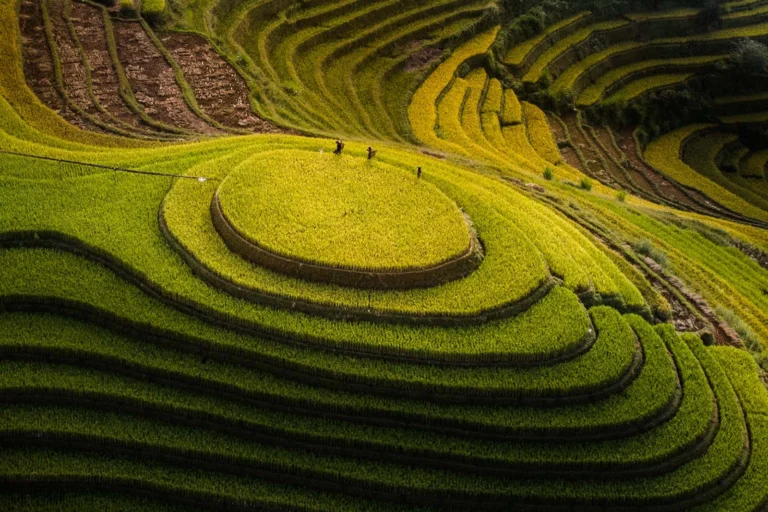
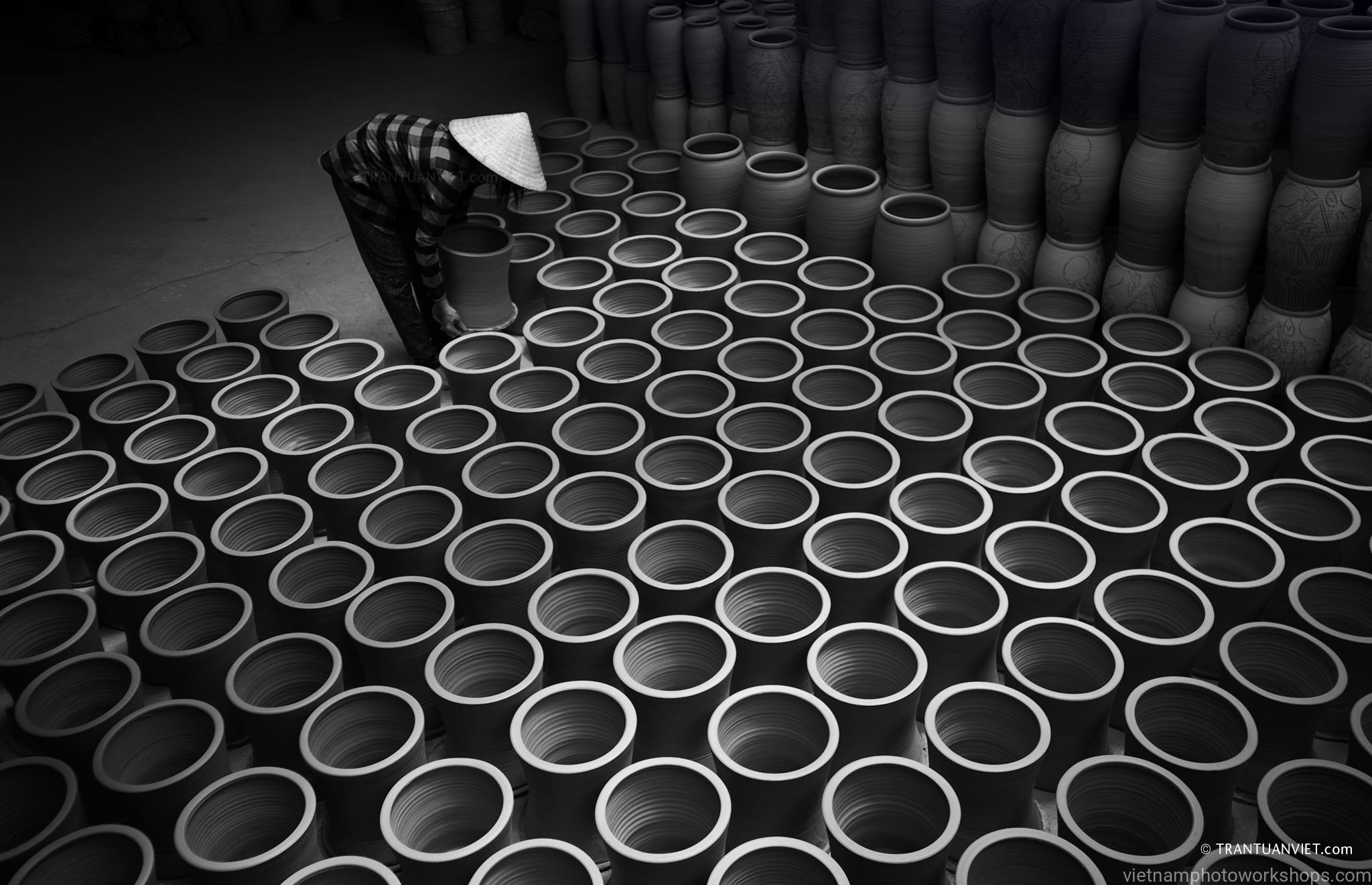
Vietnam’s traditional craft villages are far more than “tourist stops”—they are living, breathing classrooms for the visual storyteller. With over 5,400 villages dedicated to ancient arts, these locations provide a stable environment to practice complex photography techniques, from high-contrast low-light work to abstract color theory.
In this workshop guide, we’ll dive into the most photogenic crafts in the country and the technical skills you need to capture them with the depth they deserve.
1. Basket Making: Mastering Texture and Light
In some places in Vietnam, Vietnamese people treat weaving as a language of identity. For a photographer, these villages are a masterclass in Environmental Portraiture.
- The Technical Challenge: Managing the soft, directional light of a dark wooden stilt house.
- Workshop Focus: Use a wide aperture (e.g., f/1.8 or f/2.8) to create a shallow depth of field, making the intricate hemp threads “pop” against the dark background. Or use the formal f/5.6 for a daily-life shot.
- The Shot List:
- Detail: Macro shots of the indigo-stained hands of the weaver.
- Action: A slightly slower shutter speed (1/50s) to capture the rhythmic “thwack” of the loom.
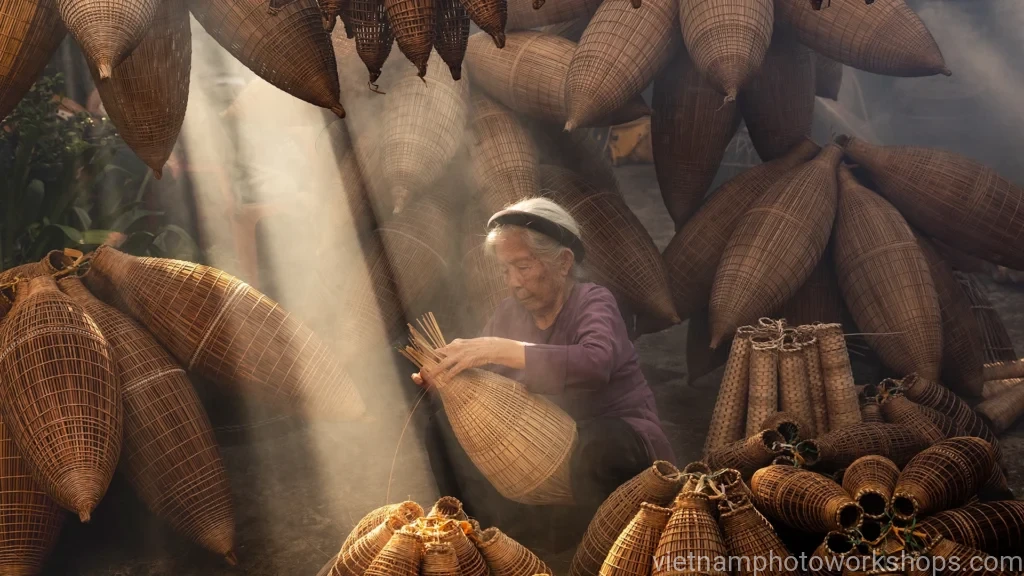
Vibrant Vietnam photo workshop October 2025, co-guide with Daniel Kordan.
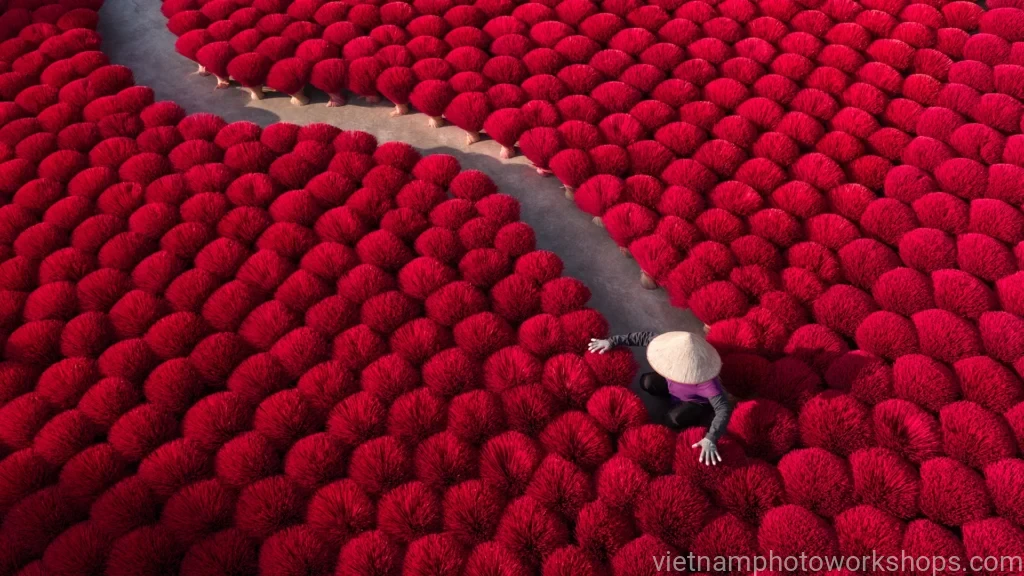
2. The Incense Villages: A Lesson in Color Theory
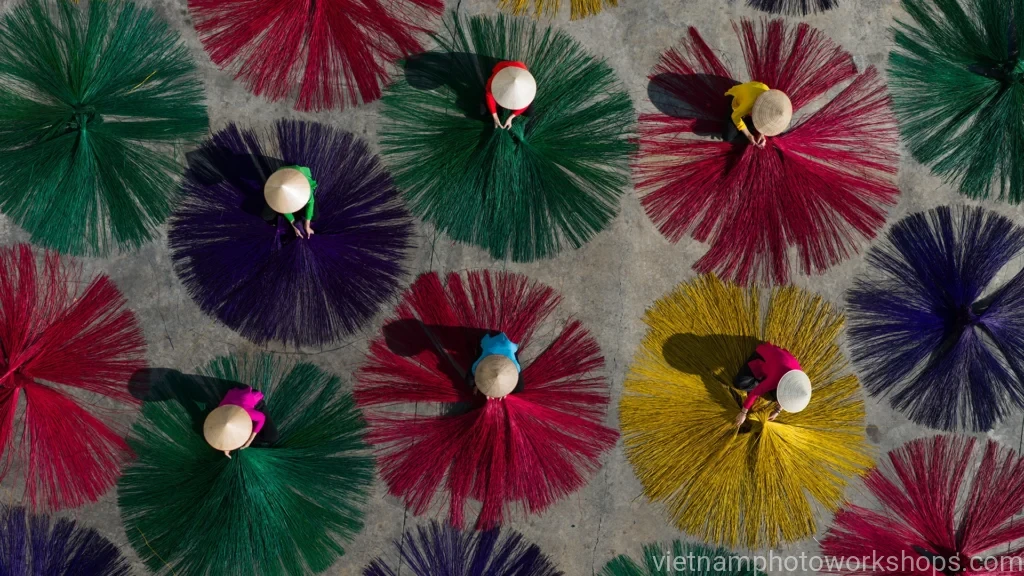
The crimson courtyards of Quang Phu Cau are arguably the most famous craft scenes in the world, brought to global attention by photographers like Tran Tuan Viet.
- The Technical Challenge: Preventing “color clipping.” Intense reds can often overwhelm a digital sensor, losing all detail in a sea of scarlet.
- Workshop Focus: We focus on Geometric Composition.
- Pro Tip: Shoot from a high vantage point (or drone) to emphasize the radial symmetry. Use a Circular Polarizer (CPL) to cut the glare off the bamboo sticks and deepen the saturation of the red dyes.
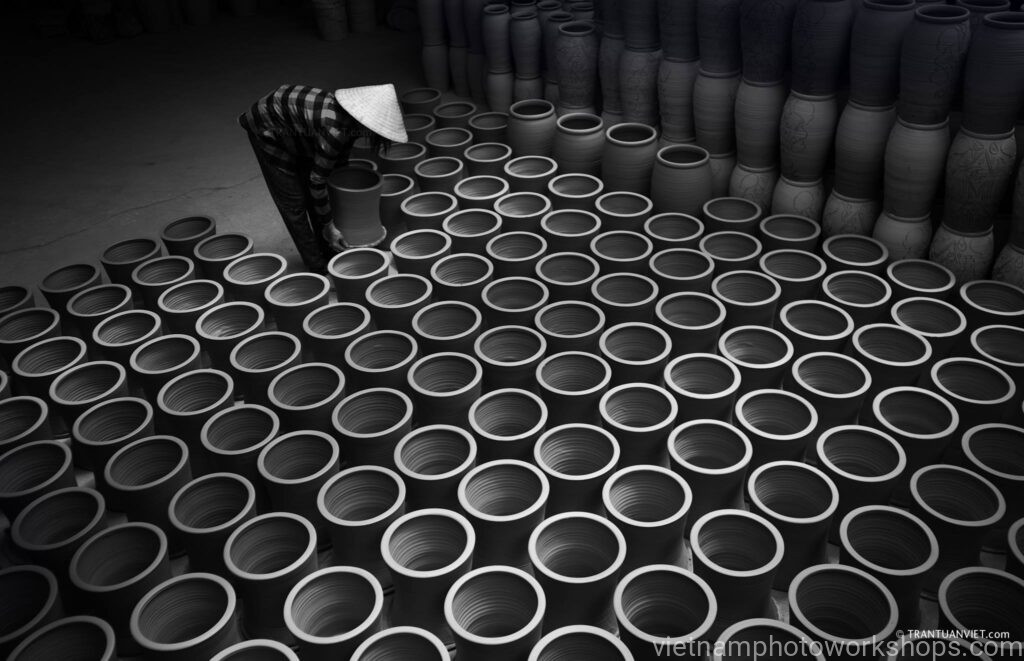
3. Pottery Villages: Mastering “Poetry in Motion”
In villages like Bat Trang or the ancient kilns of Phu Lang, the element of Fire and Earth takes center stage.
- The Technical Challenge: Capturing the motion of the potter’s wheel without losing sharpness where it matters.
- Workshop Focus: Experimenting with Shutter Speed.
- To freeze the flying clay: 1/1000s.
- To show the circular motion: 1/15s to 1/30s (using a tripod).
| Element | Photography Skill | Preferred Lens |
| The Wheel | Motion Blur / Shutter Control | 35mm Prime |
| The Kiln | Low-Light / High ISO | 50mm f/1.4 |
| The Texture | Macro / Detail | 85mm or 100mm |
4. Conical Hat Making: The Art of Visual Grace
The nón lá is the ultimate symbol of Vietnamese elegance. In villages like Chuong (Hanoi), the focus is on Soft Light and Symmetry.
- The Technical Challenge: Photographing the subtle, translucent layers of the palm leaves as light passes through them.
- Workshop Focus: Backlighting. By placing the artisan between the light source and your lens, you can capture the “glow” of the hat, highlighting the intricate stitching that is otherwise invisible.
5. Mat Weaving: Patterns and Abstract Geometry
From the Red River Delta to the Mekong, mat weaving offers a “flat-lay” paradise of vibrant dyed reeds and rhythmic looms.
- The Technical Challenge: Finding order in a busy, cluttered workshop environment.
- Workshop Focus: The Top-Down Perspective. * Pro Tip: Use a 24mm wide-angle lens to capture the artisan and the entire length of the loom. This creates a powerful “Establishing Shot” that anchors your cultural photo essay. And more easily, use a top-down shot from a drone.
Technical Toolkit for Craft Villages
To get the most out of your workshop experience, your gear and approach should be intentional:
- Lens Selection: * 35mm or 50mm: The “Sweet Spot” for environmental portraits that balance the person and their craft.
- 85mm: Perfect for “stepping back” and capturing candid expressions without intruding on the artisan’s workspace.
- The “Human First” Rule: We never start by clicking. On our workshops, we build rapport. A simple smile or a shared cup of tea “breaks the ice,” resulting in more authentic, relaxed portraits.
- Respecting the Work: These are active places of business. We teach you how to stay out of the “flow of labor” while still getting the shot.
Why a Local Workshop Leader is Essential
Navigating 5,400 villages is impossible alone. Many of the most photogenic workshops are hidden in residential courtyards or down narrow alleys that don’t appear on Google Maps.
As a local Vietnam photographer, I don’t just take you to the village; I take you to the moment. I know which weaver has the best light in her house and which kiln is being fired today. We bridge the language gap, turning a photo op into a meaningful cultural exchange.
Masterclass Philosophy: We don’t just “take” photos of artisans; we document a heritage that is fighting to survive in a modern world.